

RETAIL

Downtown's Retail Trajectory

Downtown’s retail mix appeals to locals as well as visitors, integrates independent retailers with chains and reflects a mix of longtime tenants as well as new operators. This healthy mix is a contributing factor to Downtown’s retail market resilience post-COVID.

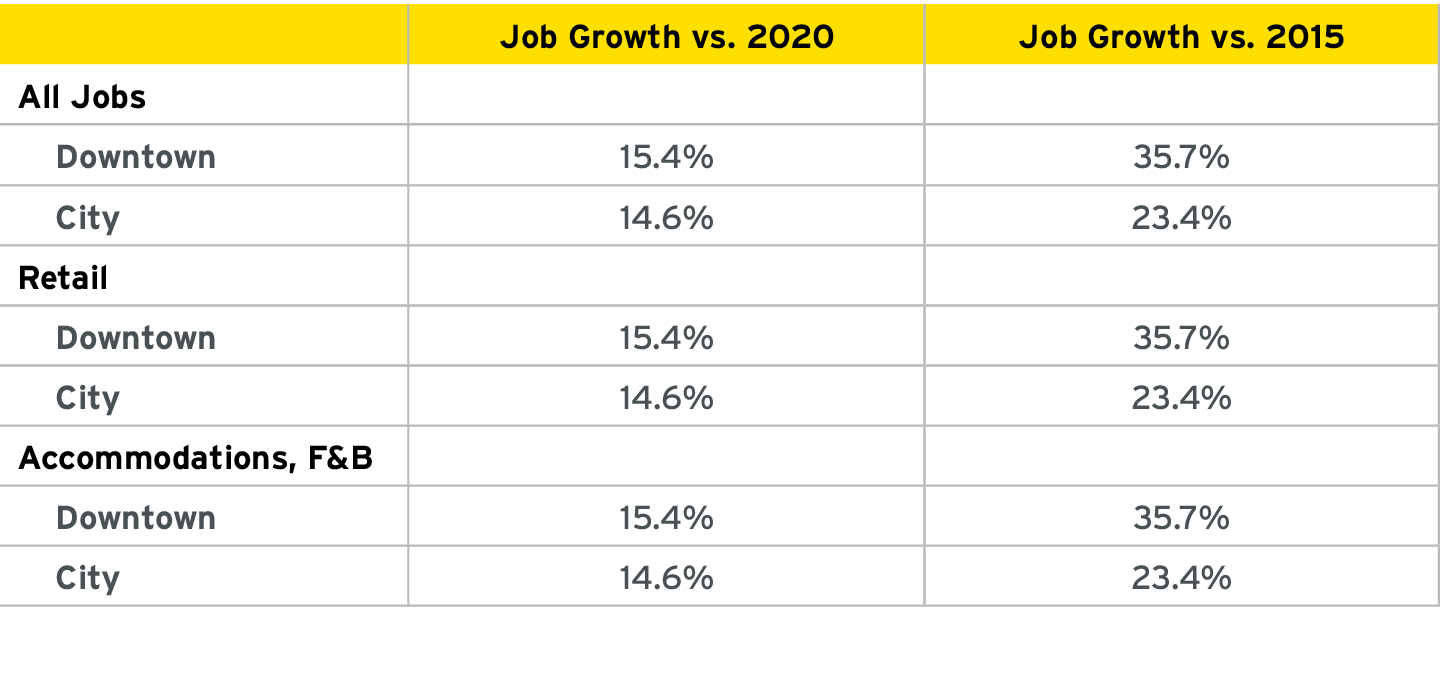
There is a growing concentration of retail, accommodation and food and beverage (F&B) jobs Downtown, with notable growth since 2020 that exceeds job growth citywide in these related occupations. Downtown represents 10% of the City’s retail trade jobs, versus 7% in 2020 and 6% in 2015. Downtown accounts for 37% of its accommodation and F&B jobs, up from 33% in 2020 and 27% in 2015.
Downtown job growth in these industry sectors deviates from city trends, exceeding overall job growth.
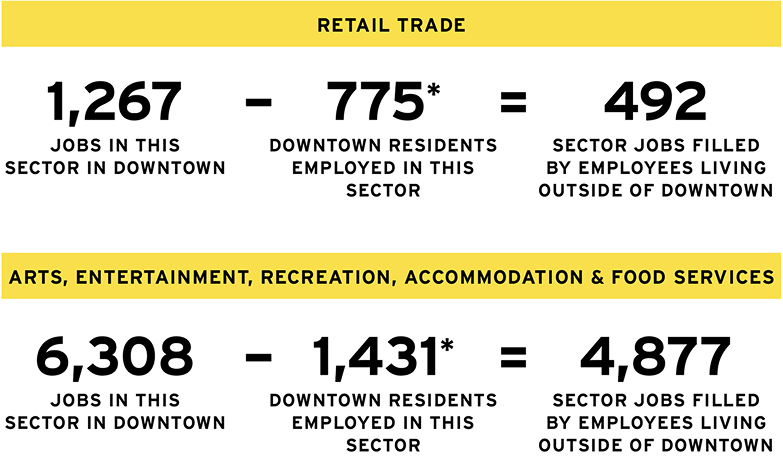
There are more people working in retail, accommodations and food and beverage jobs downtown than there are residents, indicating a limited pool of employees in close proximity, despite rising job demand in these industries.
Source: American Community Survey for resident data, OTM for Downtown Jobs
*Assumes all residents are employed in downtown establishments.  
New developments increasingly incorporate ground floor retail—a factor that enables the development to exceed the standard building height maximums, while activating the pedestrian experience. As Downtown’s retail and hospitality sector continues to grow, there will be increased pressure for housing for frontline employees in close proximity to downtown employers.

The National Business Association published in 2024 that 68 cents of every dollar spent at a small business stays in the local community versus 43 cents for large chain retailers. To retain as much favorable economic impact as possible within the community, it's important that retail workers can also live in the community. This will continue to be a challenge as new developments incorporate retail space into their plans.

1.6M

SQ FT CURRENT
RETAIL SPACE IN DOWNTOWN ST. PETE*

122K

SQ FT NEW RETAIL SPACE
UNDER CONSTRUCTION**

280K

SQ FT POTENTIAL
RETAIL SPACE
IN
DOWNTOWN ST. PETE**

By The Numbers

By The Numbers

This section analyzes employment trends, the regional education pipeline, commercial real estate performance, retail market conditions, and residential development patterns. Together, these data points provide a comprehensive view of workforce dynamics, market strength, housing mix, and comparative positioning within a regional and national context.

LEARN MORE
Growing Tomorrow’s Talent

St. Petersburg is making intentional efforts to invest in strengthening the workforce pipeline - a pipeline that begins long before career decisions are being made.

LEARN MORE

Office Space

Downtown St. Pete had numerous wins on the office front in 2025, bucking national industry-wide uncertainty stemming from the economy, rise of AI and its potential impacts on jobs, interest rates and stock market volatility.

LEARN MORE

Residential

Development activity over the past decade has significantly increased Downtown's housing stock, shifting it from primarily being a condo market to a more diversified housing mix that includes townhomes, rentals and an increasingly incentivized stream of workforce and affordable units.

LEARN MORE

Downtown's Retail Trajectory

Downtown’s retail mix appeals to locals as well as visitors, integrates independent retailers with chains and reflects a mix of longtime tenants as well as new operators. This healthy mix is a contributing factor to Downtown’s retail market resilience post-COVID.

There is a growing concentration of retail, accommodation and food and beverage (F&B) jobs Downtown, with notable growth since 2020 that exceeds job growth citywide in these related occupations. Downtown represents 10% of the City’s retail trade jobs, versus 7% in 2020 and 6% in 2015. Downtown accounts for 37% of its accommodation and F&B jobs, up from 33% in 2020 and 27% in 2015.
Downtown job growth in these industry sectors deviates from city trends, exceeding overall job growth.
There are more people working in retail, accommodations and food and beverage jobs downtown than there are residents, indicating a limited pool of employees in close proximity, despite rising job demand in these industries.
Source: American Community Survey for resident data, OTM for Downtown Jobs
*Assumes all residents are employed in downtown establishments.  
New developments increasingly incorporate ground floor retail—a factor that enables the development to exceed the standard building height maximums, while activating the pedestrian experience. As Downtown’s retail and hospitality sector continues to grow, there will be increased pressure for housing for frontline employees in close proximity to downtown employers.

The National Business Association published in 2024 that 68 cents of every dollar spent at a small business stays in the local community versus 43 cents for large chain retailers. To retain as much favorable economic impact as possible within the community, it's important that retail workers can also live in the community. This will continue to be a challenge as new developments incorporate retail space into their plans.

1.6M

SQ FT CURRENT RETAIL SPACE
IN DOWNTOWN ST. PETE*

122K

SQ FT NEW RETAIL SPACE UNDER CONSTRUCTION**

280K

SQ FT POTENTIAL RETAIL SPACE IN
DOWNTOWN ST. PETE**

By The Numbers

By The Numbers

This section analyzes employment trends, the regional education pipeline, commercial real estate performance, retail market conditions, and residential development patterns. Together, these data points provide a comprehensive view of workforce dynamics, market strength, housing mix, and comparative positioning within a regional and national context.

LEARN MORE
Growing Tomorrow’s Talent

St. Petersburg is making intentional efforts to invest in strengthening the workforce pipeline - a pipeline that begins long before career decisions are being made.

LEARN MORE
Office Space

Downtown St. Pete had numerous wins on the office front in 2025, bucking national industry-wide uncertainty stemming from the economy, rise of AI and its potential impacts on jobs, interest rates and stock market volatility.

LEARN MORE
Residential

Development activity over the past decade has significantly increased Downtown's housing stock, shifting it from primarily being a condo market to a more diversified housing mix that includes townhomes, rentals and an increasingly incentivized stream of workforce and affordable units.

LEARN MORE